Sunday, 9 May 2010

Ruined by Lynn Nottage (at the Almeida)


"A small mining town deep in the Democratic Republic of Congo.

In Mama Nadi’s bar her rules apply. No arguments, no politics, no guns.

When two new girls tainted with the stigma of their recent past arrive, Mama is forced to reassess her business priorities and personal loyalties. As tales of local atrocities spread and tensions between rebels and government militia rise, the realities of life in civil war provide the ultimate test of the human spirit."

Background: As Ann's birthday gift Gary and I took her and Camilla to see Ruined at the Almeida. I'd managed to shield myself from all the reviews - something which I felt pretty comfortable doing in this specific instance seeing as the play arrived in London as the most awarded American play of 2009 - and had only a sketchy idea of the play's content. I don't remember having a stifle a tear in the first half, but almost every scene after the interval proved to be a tear-jerker and I had to stay seated during the standing ovation in case I lost all self-control and turned into a heaving, snotty sobfest.

Impressions: Although the production and play have their faults, the material is both thought-provoking and deeply moving. In what felt at first like a series of relatively independent vignettes, each character reluctantly reveals the ways they have suffered and been 'ruined' by the conflict in the Congo. The two most striking revelations involving the sassy, imperious and seemingly indifferent, my-father-was-the-chief Josephine and, in the play's final scene, Ma Nadi herself. In the first, Josephine is the centre of attention in the bar, dancing with abandon as the crowd cheer and applaud. As the pace of the music quickens, however, her movements become less calculated and elegant and more desperate and frantic. The horror on her face before the other girls move in to rush her behind the bar is more eloquent than any dialogue the character could have been given. Here in one simple, wordless scene the most flimsy of characters becomes a heartbreaking casualty. Wonderful and chilling.

In the second scene, Ma Nadi reveals her refusal to accept Christian, the trader's marriage proposal rests on the fact that she too is 'ruined' - mutilated by rape and torture. The scene suffers from a kind of predictability, but the actors pour so much into their performances, channeling so much raw emotion, that to feel nothing is to reduce oneself to a robot.

What I'm left with is a reminder of the terrible suffering endured by millions of people every day. I am so so lucky.

Also: Play has so many echoes of Mother Courage that it has to be a direct inspiration. And, lo, here is an excerpt from the Guardian's interview with the playwright: Ruined, which opens at the Almeida next week, was originally intended as an adaptation of Bertolt Brecht's Mother Courage by way of Congo. In transporting the action of Brecht's play, set around the Thirty Years' War in 17th-century Europe, to 21st-century Africa, Nottage wanted to expose the horrors endured in a country ravaged by war – and especially by women.

Review Excerpts: "This is a play not just about brutality but also about survival, as Indhu Rubasingham’s exemplary production makes clear."

Monday, 3 May 2010

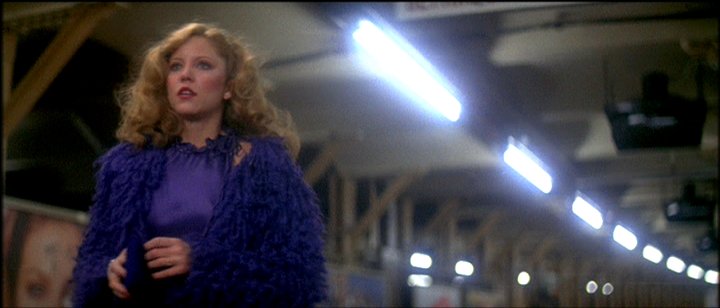
Dressed to Kill - Brian de Palma (1980)


Ha, ha, ha, ha, ha. thoughts/review to come soon.

Here's the synopsis from the wiki-page:

Kate Miller is a sexually frustrated housewife who is in therapy with New York City psychiatrist Dr. Robert Elliott. During an appointment, Kate attempts to seduce him, but Elliott rejects her advances. Kate goes to the Metropolitan Museum, where she for ten dialogue-free minutes has an unexpected flirtation with a mysterious stranger. Kate and the stranger "stalk" each other through the museum until they finally wind up outside, where Kate joins him in a taxi. They immediately begin to have sex in the cab, and their experience continues at his apartment. Hours later, Kate awakens and discreetly leaves while the man is asleep. But first, out of curiosity, she rifles through some of his desk papers and discovers that he has a sexually transmitted disease. Mortified, she leaves the apartment and gets in the elevator, but on the way down Kate realizes that she has left her wedding ring on the stranger's nightstand. She rides back up to retrieve it. The elevator doors open on the figure of a tall, blonde woman in dark sunglasses wielding a straight razor. Kate is slashed to death in the elevator.

A high-priced call girl, Liz Blake, happens upon the body and catches a glimpse of the killer, therefore becoming both the prime suspect and the killer's next target. Dr. Elliott receives a bizarre answering machine message from "Bobbi", a transsexual he is treating. Bobbi taunts the psychiatrist for breaking off their therapy sessions, apparently because Elliott refuses to sign the necessary papers for Bobbi to get a sex change operation. Elliott eventually visits Bobbi's new doctor and tries to convince him that Bobbi is a danger to herself and others. The police are less than willing to believe Liz's story, so she joins forces with Kate's revenge-minded son Peter to find the killer. Peter is an inventor. He uses a series of homemade listening devices and time-lapse cameras to track patients from Elliott's office. They catch Bobbi on camera, and soon Liz is being stalked by a tall blonde figure in sunglasses.

Several attempts are made on Liz's life. One is thwarted by Peter, who rescues Liz in the nick of time by spraying Bobbi in the New York City Subway with some homemade mace. Liz and Peter scheme to get inside Dr. Elliott's office to look at his appointment book and learn Bobbi's real name. Liz baits the therapist by stripping to lingerie and coming on to him. She distracts him long enough to make a brief exit and leaf through his appointment book. When she returns, it is Bobbi rather than Dr. Elliott who confronts her; they are the same person. Elliott/Bobbi is shot and wounded by a female police officer who looks like Bobbi and has been trailing Liz. She is the tall blonde figure who was tracking Liz all along. Elliott is arrested by the police and placed in an insane asylum. It is explained by a psychiatrist that Elliott wanted to be a woman, but his "male" side wouldn't allow him to go through with the operation. Whenever a woman sexually aroused Elliott, it was "Bobbi," who represented the female side of the doctor's personality, who became threatened. In a final sequence, Elliott escapes from the asylum and slashes Liz's throat in a bloody act of vengeance. She wakes up screaming, realizing that it was just a dream.

The City & The City - China Miéville (2010)

Poorly-written winner of the Arthur C. Clarke Award. A lovely premise which is undermined both by the disappointing details and the poor, sometimes ludicrously opaque and clunky writing.

As a metaphor for the psychological and physical conditions of living in any modern city, the conceit of having two cities exist side-by-side but in parallel universes seems particularly potent. While being a little obvious, it's the kind of metaphor that science fiction is built on - a device that allows contemporary conditions, concerns and sensibilities to be examined or appreciated in a new light, or at least at some distance. Still, Miéville manages to combine his clunky prose with an overwhelming interest in plot mechanics in a way that diminishes the resonance of the metaphor until it becomes virtually unimportant. We may as well be reading about a detective on another planet, or in another dimension for all squandered potential of the novel's setting. The incredibly smudged and pale characterization (or lack thereof) doesn't help matters. While the plot is skillfully constructed and even manages to be gripping at times, I felt disappointed.

And here's the synopsis for future reference, courtesy of the Wikipedia entry:
Inspector Tyador Borlú, of the Extreme Crime Squad in the European city-state of Besźel, investigates a brutal murder. He soon learns that the victim had been involved in the political and cultural turmoil involving Besźel and its twin city of Ul Qoma. These two cities actually occupy much of the same geographical space, but via the volition of their citizens (and the threat of the secret power known as Breach), they are perceived as two different cities. A denizen of one city must dutifully 'unsee' (that is, ignore, or fade into the background) the denizens, buildings, and events taking place in the other city — even if they are an inch away. This separation is emphasized by the style of clothing, architecture, gait, and in the manners denizens of the cities generally carry themselves. Residents of these cities are taught from childhood to recognize things belonging to the other city without actually seeing them. Ignoring the separation, even by accident, is viewed as a horrible crime by the citizens of the two cities — one which might be worse than murder - incurring swift and fatal punishment by Breach.

Sigh.

Friday, 16 April 2010

Dr. Jekyll and Mr. Hyde


To anyone inured to Hollywood's long tradition of discrete evasion, the first thing that strikes one about Rouben Mamoulian's Dr Jekyll and Mr Hyde (1931) is how unabashedly sexual the whole thing is. The original author, Stevenson, made no bones about the fact that Hyde indulged in the unmentionable lusts that Jekyll repressed, but this film seems to delight in lurid innuendo.

Engaged to an English society lady (with a distinct American accent), Jekyll is frustrated by her father-in-law's insistence that they delay the marriage ceremony (and, by exaggerated implication, the consummation). Rather conveniently Jekyll makes a scientific breakthrough by creating a chemical concoction that 'splits' the drinker into two personalities - the virtuous and noble on the one hand, and the dastardly and filthy-minded. Anyway, Hyde inflicts all of his perverted lusts on a poor prostitute, Ivy, that he practically imprisons in a lush shag pad while his fiancé and her father are out of the country. What follows is a classic tale of addiction as Jekyll gradually loses control to Hyde who eventually kills Ivy and attempts to rape his fiancé Muriel before being apprehended and killed by the authorities.

The creature effects are hysterical in their blatant presentation of Hyde as a kind of hairy Neanderthal (low forehead included). Impure thoughts are gonna turn you into a big, hairy ape-man didn'tya know? Like masturbating gives you hairy palms. Not that Mamoulian is that clear-cut in his judgements, at least as far as the direction/mis-en-scene is concerned.

Fredric March apparently won the Oscar for Best Actor for this performance. Wowza.

Saturday, 3 April 2010

How to Train Your Dragon 3D


HTTYD, for short, makes up for its uninspiring plot and rather threadbare characterization with some sparkling character design on the main dragon [have a look at the pics] and some nimble, even occasionally spectacular, use of 3D. Was my experience of the film enriched by the 3D? Most definitely yes. I didn't feel it as strongly with Avatar, but HTTYD has settled the 3D debate, for me at least. Critics of 3D will henceforth be relegated to the Curmudgeon-camp.

Sunday, 7 February 2010

Rope - At the Almeida


A wonderful production of what can hardly be called a classic theatrical text.

Traditionally, the piece is seen as a study of two Oxford undergraduates who, in committing a murder to show their freedom from moral restraints, hold the mirror up to Nietzsche. But the director seems less interested in the killers than in their charismatic guest, Rupert Cadell, at a party staged around a chest containing the victim's body.

"Rupert, a war-damaged Wildean poet filled with ennui, is the play's most original creation. Bertie Carvel suavely demonstrates that Rupert is a man who minces everything but his words, but also reminds us that the play is really about the character's moral awakening: Carvel offers a riveting portrait of an affected nihilist who discovers the hollowness of his credo, that the slaughter of 1914-18 has devalued individual murder."

Rupert more than justifies the revival - a combination of Truman Capote, Eric Cartman and Hercule Poirot. There's a beautiful passage delivered by Rupert as he teases the two murderers, delaying them while the police gather outside. Ruminating on the lateness of the evening - it is five and twenty to eleven - he delivers what I thought was a beautiful description of that haunting hour when theater shows are about to end, cabaret shows have yet to begin, taxis and busses throng the streets as punters rush home to go to bed (only to wake up to a day almost exactly the same as the day that preceded it), ruined women saunter down dark streets etc etc and "pleasure itself is found wanting."

Where's the sequel? Huh? Rupert-focused obvs.

"Bertie Carvel gives the finest performance of all, though, as a wickedly camp, coldly amusing aesthete, a survivor of the trenches with a tin leg and an apparently icy heart who finally supplies this cruel and brilliant play with what small measure of compassion it possesses."

Rupert's towering, don king-esque hair is also a lovely touch. A mincing, limping, amoral, judgemental, alcoholic, brilliant detective. Mmmm, sounds a lot like House actually. oops. Guess it's been done.

NOTE: These pictures of Rupert don't nearly do justice to just how strange and "queer" a presence his is (or was, or something...)


Friday, 23 October 2009

Word of the Day

Lambent

–adjective

1.
running or moving lightly over a surface: lambent tongues of flame.
2. dealing lightly and gracefully with a subject; brilliantly playful: lambent wit.
3. softly bright or radiant: a lambent light

Origin:
1640–50; lapping, prp. of lambere to lick wash (said of water or fire)

Sunday, 26 April 2009

Let the Right One In (2008)


Yeah, yeah, yeah, it's good, but not that good. Too much of it is too carefully and obviously staged for my liking. And yes, the swimming pool scene is breathlessly innovative and wonderful, but why does the bully keep the heroes head under the water when his brother and his brother's friends are being torn apart by a flying teen vampire? Coz it looks good that's why. Just a tad too contrived.

Paranoid Park (2007)


Argh, this movie is excruciating. Unfortunate teen kills security guard in grisly train bifurcation incident! Teen is basically nice, super-normal boy who doesn't deserve anal rape in prison! Will teen be discovered?!? Aaaaaarrgh?!?! The suspense and dread that permeate this movie make it very difficult viewing, despite how beautiful and lush it is.

As far as the performances go, Van Sant appears to have taken a leaf out of 'The Hills guide to acting and dramatic arts'. I think almost all the actors are amateurs. The teens in particulat are achingly naturalistic. Naturlistic in the sense that they are awkward and wooden and self-conscious in the way only teens can be, and aching in the sense that all the awkward self-consciousness is excruciating!

You can debate whether or not the film is realistic or argue, as some critics have, that the depiction of teenagers is aestheticized and clichéd but there's something that feels very tru about the film. This is interesting and provocative film-making. Still, ick.

The Amazing Adventures of Kavalier & Clay (2009) - Michael Chabon


A beautiful and at times moving and evocative homage to comic books. The opening chapters of the book, revealing details of Joseph Kavalier's study of escapology and his eventual escape from prague in a large coffin containing the actual-factual Golem, are spellbinding. The atmosphere of simultaneous dread and hope that Chabon manages to sustain through this thread is as thrilling as anything I've seen in the cinema, and the image of the Golem, in fact the very idea of the Golem, lingers and persists through the course of the entire novel. The simple introduction of this piece of Jewish folklore, so obvious and natural once Chabon has done it, serves to link the notion of the superhero to a series of fundamental human desires and dreams and primes the reader for what's to come.

Despite its moments of brilliance the novel doesn't quite hang together in my opinion, becoming increasingly sketchy and unwieldy as the plot tries to find some kind of resolution. I wonder if, like a comic book series, any kind of ending would remain unsatisfactory. After having created such wonderful and engaging heroes it's impossible for the reader to imagine that their adventures could not carry on beyond the bounds of this story. The conclusion therefore feel a little forced ad clumsy to me. This narrative failing, if that's what I can call it, is mitigated by rich veins of characterisation which run through the book, as well as scenes which are so well-imagined that they feel both utterly real and yet also utterly thrilling. Due to my own personal (and especially romantic) interests I found the development of Sam Clay's character particularly engrossing, and the scenes between him and his wholly unbelievable suitor have an emotional veracity that's completely devastating.

There's a scene where Clay and the aforementioned love-interest, Bake (Tracy Bacon), make their way to the abandones remains of the New York World Fair and clamber inside the Perisphere - an Epcot like sphere containing a scale model of the city of the future [see pics of the real thing include in this post]. Chabon describes the intricate workings of the display as Bake and Clay gain entry through some sort of service hatch...describing them as the dernier cri of the art of clockwork machinery, finally...

"Sammy went over and stood beside Bacon for a moment. Then he eased himself down on the ground beside him. He folded an arm under his chest and, inclining his head slightly, squinted his eyes, trying to lose himself in the illusion of the model...he was a twentieth of an inch tall, zipping along an oceaninc highway in his little antigravity Skyflivver, straking past the silent faces of the aspiring silvery buildings. It was a perfect day in a perfect city. A double sunset flickered n the windows that threw shadows across the leafy square of the city. His fingertips were on fire.
"Ow!" Sammy said, dropping hislighter. "Ouch!"
Bacon let his own flame go out. "You have to kind of pad it with your necktie, dopey," he said. He grabbed Sammy's hand. "This the one?"
"Yeah," Sammy said. "The first two fingers. Oh. Okay."
They lay there for a few seconds in the dark, in the future, with Sammy sore fingertips in Tracy Bacon's mouth, listening to the fabulous clockwork of their hearts and lungs, and loving each other.

Okay, so I know it's bit hammy, but I'm normally starved for writing of this quality that includes any kind of man-on-man action (just to be a little crude so that things don't get too soppy). I know it's just a failure of imagination on my part, and that all great love-stories should have this effect on me, but gosh, sometimes this is just necessary.

There's an even better scene later:

"Sammy pursed his lips and allowed a long strand of saliva to dangle downward, tipped by a thick bubbled head. The bubble lowered itself like a spider until it hung just over Bacon's face..."Ew," said Bacon. He thrashed from side to side and struggled under the weight of Sammy on his wrists, while Sammy dangles the silvery thread over him again. Then, abruptly, Bacon stopped struggling. He looked at Sammy, level, calm, and with a dangerous glint in his eye; of course he could have freed himself easily...His look said so. He opened his mouth. The pearl of spit dangled. Sammy cut the thread."

Brilliant.

The novel's also interesting because of the way it highlights the fact that so many of America's most enduring myths, and the expression of those myths in new media (film/Hollywood, comics etc) were created by Jewish immigrants. Food for thought, no?

Basic Plot Summary to refresh my memory: Samule Clay awoken late one evening by the unexpected arrival of his Czech cousin, Joe Kavalier. After studying escapology in Prague, Joe manages to escape the Third Reich's clutches by being smuggled out of Prague in a coffin containting the Golem. A talented artists, Joe is quickly enlisted by Sammy in his plans to break into the burgeoning world of comic book [Superman having just recently appeared in the pages of Adventure Comcs]. With Joe's assistance Sammy manages to convince the vaguely sleazy boss at the novelty company he toils for to fund their foray into comic book adventures. Amazing Midget Radion Comics launches with the adventures of The Escapist, Kavalier and Clay's most successful creation, and finds almost immediate popularity and profitability. The fate of his family in Prague continues to gnaw away at Joe who channels his anger into the pages of the Escapist - superpowered nemesis of axis forces everywhere. Sammy and Joe earn unprecendented money, but their paltry salaries are dwarfed by the profits of their employers. Joe meets and falls in love with Rosa Parks, while Sammy stumbles into an unexpected romance with a handsome actor, Tracy Bacon. Joe manages to secure a place for his brother on a boat rescuing Jewish children from Europse. Boat is torpedoed by Germans. Joe enlists. Through a cruel twist of fate Sammy and Bake are arrested for lewd behaviour after a gay getaway is busted by the police. Humiliated and ashamed, Sammy breaks off his affair with Bake and marries Rosa in order to allow her to have Joe's baby. In another cruel twist of fate, Joe is stationed in Antarctica [The Arctic?] and narrowly survives the accidental gassing of his fellow soldiers before hunting down a German expedition consisting of a lone German scientist. Joe finally makes it back to NY, but hides out in the Empire State Building for 10 years before inadvertantly making contact with his family and meeting his son. Sammy becomes embroiled in the congress hearings into the morally dubious nature of comic books and is, in effect, outed on prime-time TV. Freed from pretences, Sammy kinda escapes his family and moves to LA, leaving Joe and Rosa to raise their son Tommy (named after Joe's dead brother). The End.